
Oil Prices, Shipping and Chip Shortages Could Tighten Philippine Car Supply into 2027
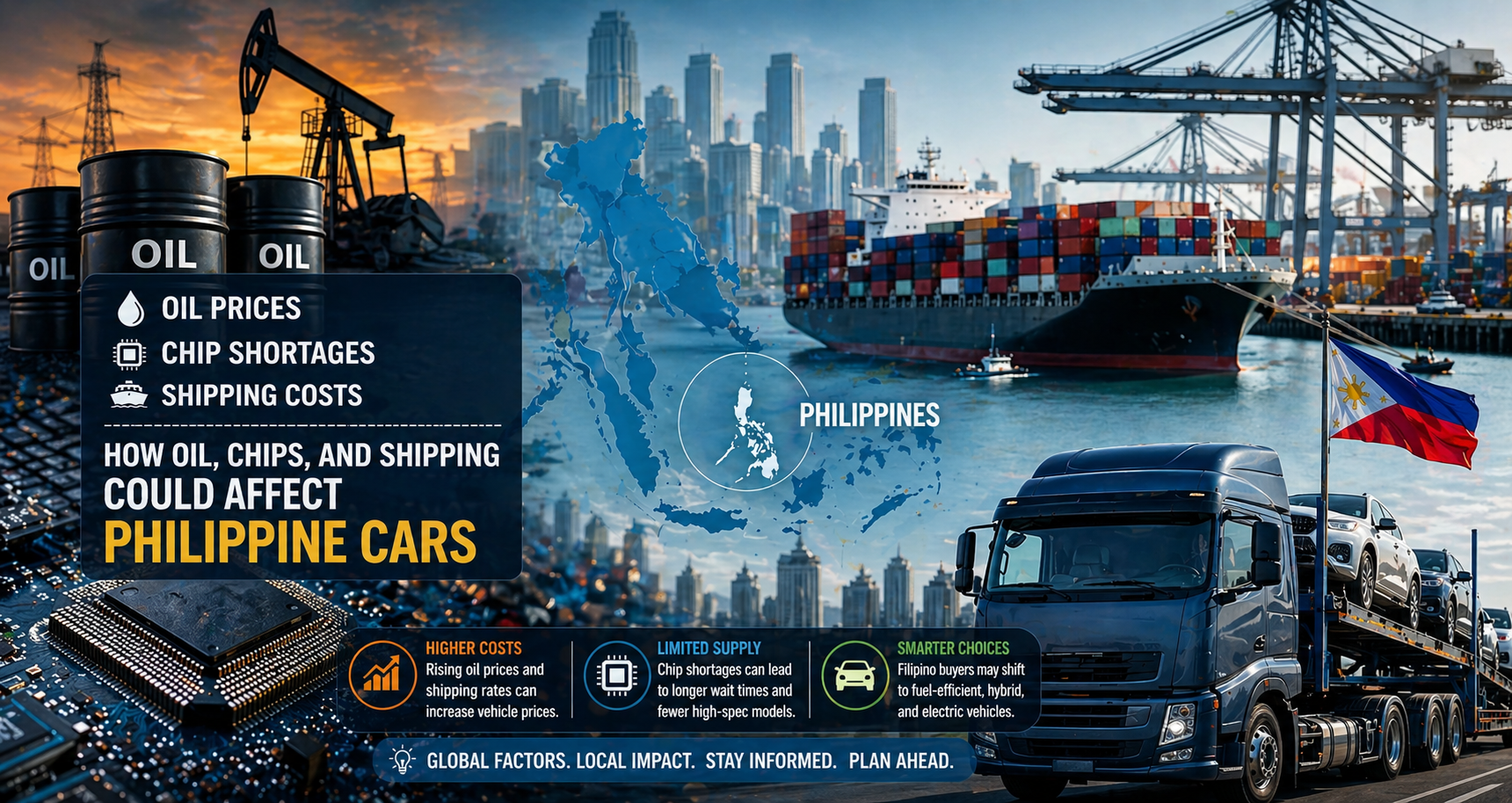
Rising oil prices, tighter shipping networks, and renewed competition for semiconductor supply are creating a triple threat for Philippine car buyers in 2026. As tensions in the Middle East enter their seventh week, the risk is no longer limited to fuel prices. It now extends to vehicle costs, model availability, and delivery times.
Why Philippine Car Prices May Rise Again in 2026
Rising oil prices, tighter shipping networks, and renewed competition for semiconductor supply are creating a three-part supply shock for Philippine car buyers in 2026. As tensions in the Middle East enter their seventh week, the risk is no longer limited to fuel prices. It now extends to vehicle costs, model availability, and delivery times.
What makes the current environment more serious is that the automotive industry was already dealing with structural pressure before the latest geopolitical shock. Shipping networks remain fragile, automotive chip lead times are still elevated, and AI demand is absorbing a growing share of global semiconductor capacity. For Philippine buyers, that combination could mean higher prices arrive before outright shortages do.
Unlike the pandemic, this disruption is not driven by demand spikes alone, it is being reinforced by geopolitics, energy costs, and structural shifts in semiconductor demand.
Strait of Hormuz Risks, Rising Oil Costs and Secondary Supply Chain Threats
Tensions involving Iran and the Strait of Hormuz escalated in late February, and markets have already felt the first impact. Brent crude recently moved above $100 a barrel, triggering higher fuel prices across import-dependent economies including the Philippines.
But the longer disruption lasts, the greater the secondary risks become. Higher oil prices raise the cost of freight, plastics, chemicals, batteries, and industrial production. Car manufacturing is especially exposed because modern vehicles rely on complex global supply chains, with components often crossing several borders before final assembly.
For the Philippines, where many popular models depend on regional production hubs such as Thailand, Japan, South Korea, China, and Malaysia, rising costs or slower logistics in these markets are likely to feed directly into local vehicle prices and availability.
As shown in the table below, the risks facing automakers now extend well beyond fuel prices, from semiconductors and shipping to battery metals and raw materials.

Automakers are being squeezed from both sides: oil shocks are lifting costs, while AI demand is absorbing chip capacity. If conflict drags on, Philippine buyers may face higher prices and fewer choices.
While a wide range of materials from rare earths to battery metals could affect vehicle production, not all risks are equally immediate. In the current environment, three pressure points stand out: shipping, semiconductor supply, and the growing competition from AI for chip capacity. These factors are already under strain, closely linked to rising energy costs and geopolitical disruption, and are likely to have the most immediate impact on vehicle availability, pricing, and delivery times in the Philippine market.
Shipping Delays Could Be the First Warning Sign
Shipping disruptions are often the earliest signal that geopolitical risk is spilling into the wider economy. Higher insurance premiums, rerouted vessels, and tighter tanker availability can quickly push up freight costs.
For the Philippines, where most vehicles and many parts arrive by sea, that translates directly into higher landed costs and slower deliveries. Shipping lines have already warned that conflict in key routes is increasing surcharges tied to fuel, insurance, and storage.
The chart below shows that current container shipping costs remain relatively stable and well below pandemic-era peaks. However, this rate per container will be one of the most important indicators to monitor over the next six months. Several shipping companies have already begun cancelling routes or adding surcharges as operating costs rise.

German shipping firm Hapag-Lloyd summarized the pressure clearly, saying:
“More broadly, the conflict has increased complexity and costs across the shipping industry, including higher bunker prices, insurance premiums, storage costs, and inland transportation expenses.”
Shipping costs are not yet spiking, but the conditions for a rapid increase are already forming. Even moderate rises in container rates can quickly feed into the landed cost of imported vehicles and parts, potentially leading to lower inventories, longer waiting lists, and gradual price increases in the Philippine market.
Semi Conductor Squeeze is not Over

The semiconductor situation has moved past the acute shortages seen during the pandemic, but it remains structurally tight and far from normal. Modern vehicles rely on hundreds of chips for engine management, safety systems, infotainment, sensors, hybrids, and EV drive-trains, making automakers highly sensitive to even small disruptions in supply.
Much of this demand is concentrated in older “mature-node” chips, which attract less investment than the advanced processors used in AI and data centers. As a result, automotive supply chains remain vulnerable when capacity tightens or capital shifts toward higher-margin segments.
At the same time, key inputs into semiconductor production, including helium and specialty gases are emerging as additional pressure points. Any disruption to their supply, particularly from rising geopolitical tensions or shipping delays, could quickly ripple through chip manufacturing.
As the semiconductor lead-time chart shows, the crisis phase of the pandemic may have passed, but the system has not fully normalized. Some automotive categories still sit in the 30 to 42-week range, well above the pre-pandemic norm of 16 to 20 weeks, and in some cases, even higher than pandemic-era averages.
For Philippine car buyers, this translates to months of waiting for critical components, slowing production and extending delivery times for popular models. However, the true risk to these lead times isn't just "high demand", it's a raw material bottleneck that many are overlooking.
In April 2026, SK Hynix, which supplies two-thirds of the world’s memory chips, reported that they only have 4 to 6 months of Helium reserves remaining. Because Qatar provides roughly 30% of the world’s high-purity helium, any further disruption in the Strait of Hormuz (the primary transit point for these gases) could turn the current "squeeze" into a hard production stop. It isn’t just about having enough factories; it’s about having the raw gases required to keep the machines running.
This vulnerability means that even a minor escalation in the Middle East could cause those 42-week lead times to spike again, keeping the Philippine automotive market in a state of "structural tightness" well into 2027.
AI Is Becoming a Direct Competitor for Chips

Automakers are no longer competing only with consumer electronics, they are now competing directly with the rapid expansion of artificial intelligence infrastructure.
A recent Reuters report highlights just how intense this shift has become. Samsung, the world’s largest memory chip-maker, reported that its semiconductor profits surged nearly 50-fold in early 2026, driven overwhelmingly by demand from AI data centers. In fact, chip-related earnings accounted for over 90% of total profits, underscoring how dominant AI demand has become in the industry. This marks a structural shift as semiconductor supply is no longer just cyclical, it is being permanently reshaped by AI demand.
At the same time, chip-makers are warning that supply is struggling to keep up. Samsung executives noted that current supply “falls far short of customer demand”, and that the gap between supply and demand is expected to widen further into 2027 as AI investment continues to accelerate.
This has important implications for the automotive sector as Chip-makers are increasingly allocating capacity to high-margin products such as high-bandwidth memory (HBM) used in AI accelerators, while supply for conventional automotive semiconductors becomes more constrained. The result is a structural imbalance:
In practical terms, this means automakers are not just facing shortages, they are competing in a market where their demand is less profitable and therefore less prioritized.
AI demand is already outpacing supply and the gap is expected to widen into 2027. For automakers, the competition for chips is only just beginning.
What Philippine Car Buyers Should Expect in H2 2026
If conflict and supply pressure continue, the Philippine market is likely to feel the effects in three stages and the impact is likely to unfold gradually rather than all at once.
1. Higher Ownership Costs
This has already begun. Rising fuel prices, transport inflation, and broader operating costs increase the total cost of owning a vehicle.
2. Pricing Pressure and Delays
Buyers should expect:
- Gradual increases in suggested retail prices
- Fewer discounts and promos
- Longer waits for certain trims or colors
- Tighter supply of hybrids, EVs, and imported models
3. Demand Shifts
As fuel prices rise, more buyers may move toward efficient vehicles, but that could create an irony, where hybrids and EVs may be the very models hardest to source.
Which Vehicles Are Safest and Most At Risk
More Resilient Supply
Mainstream gasoline models with strong ASEAN production footprints, including many Toyota, Mitsubishi, Isuzu, Suzuki, and Nissan units.
More Vulnerable
- Hybrids
- EVs
- Premium imports
- Niche models with small allocations
- High-spec variants dependent on advanced electronics
Conclusion
Taken together, the data suggests the next disruption will not resemble the sudden shutdowns of the pandemic era. Instead, it is unfolding as a slow-burn supply squeeze, driven by higher freight costs, structurally tight chip supply, and intensifying competition from AI.
While the Philippines may avoid an outright vehicle shortage in 2026, the market is clearly shifting. Prices are likely to rise before supply fully tightens, waiting times will extend, and availability will become more uneven across models and segments.
For buyers, the risk is no longer just higher prices, it is reduced choice and longer delays in a market that is becoming structurally constrained well into 2027.


